Sectional Sofa Size Guide for Small Edmonton Condos
How to measure for a sectional in a small Edmonton condo - depth, back height, clearances, chaise orientation and getting it through the elevator.
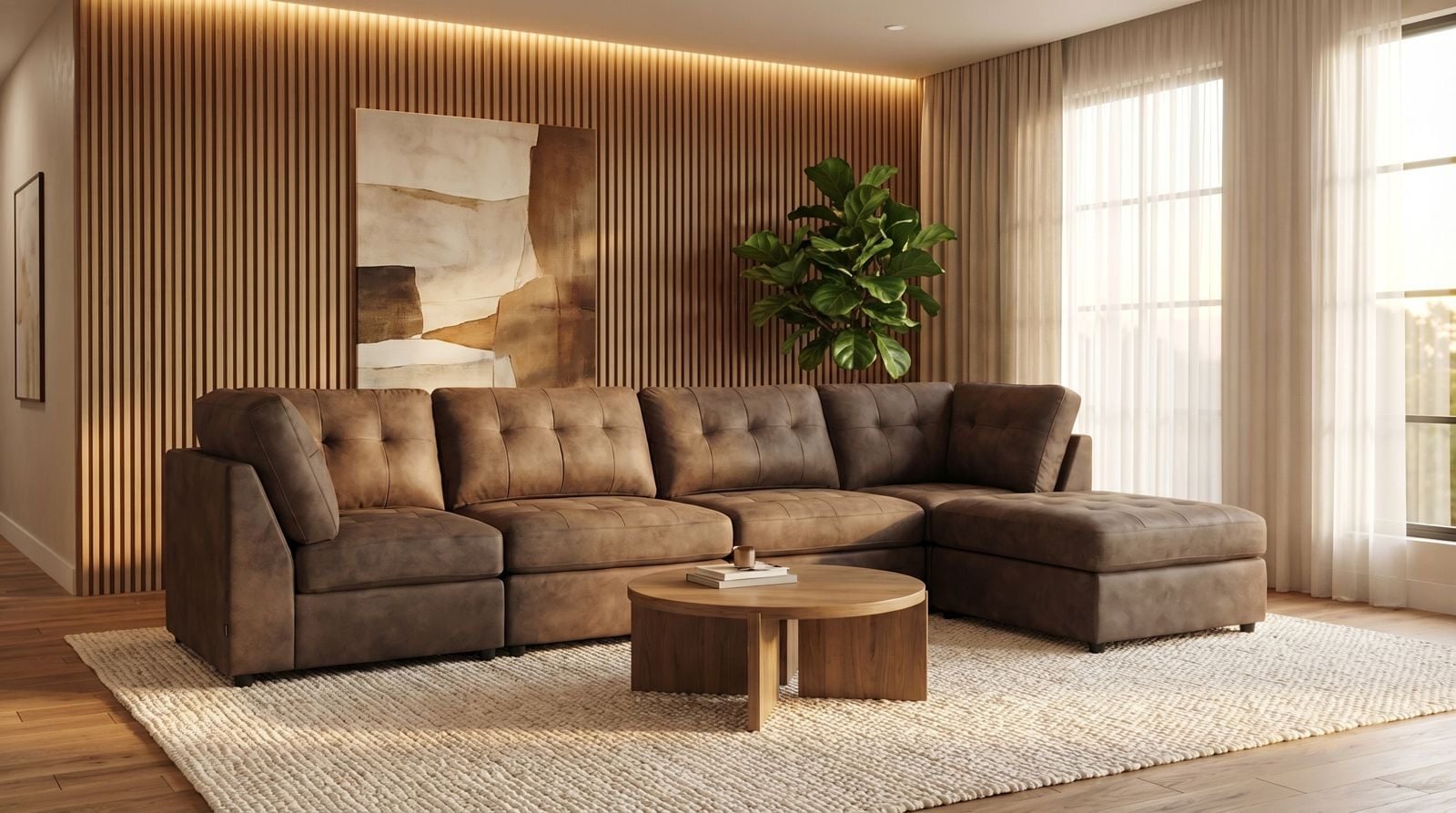
A sectional is the single best piece of furniture you can put in a small Edmonton condo, and it is also the easiest one to get badly wrong. Get the dimensions right and a sectional seats more people than a sofa-and-loveseat pairing while taking up less wall. Get them wrong and you spend the next eight years squeezing sideways between the coffee table and the ottoman.
This guide is the measuring process our designers walk through with condo owners at our Gateway Blvd showroom. It is written for the realities of Edmonton living: Oliver walk-ups, downtown towers, Windermere and Griesbach infills, and the tight stairwells that come with all of them.
Measure the room before you fall in love
Almost every sectional regret traces back to a room that was never properly measured. Before you shop, sketch the room with real numbers and mark the fixed obstacles.
- Wall lengths for every wall the sectional could sit against.
- Window sill heights. A sectional back taller than the sill will cut across the glass and block light, which matters a great deal in an Edmonton winter.
- Door swings, including closets and the balcony slider.
- Heat vents and cold-air returns. Covering a vent in a condo makes a room noticeably colder and works the furnace harder.
- The TV wall and the viewing distance from where you will actually sit.
- Electrical outlets, especially if you want a power reclining sectional.
Tape the footprint on the floor with painter's tape and live with it for a day. Walk the room. Open the closet. Sit where the sofa will be. That single afternoon prevents the most expensive furniture mistake people make.
The clearances that decide whether a room works
Dimensions on a spec sheet tell you what a sectional occupies. Clearances tell you whether the room still functions around it.
- Walkways: 36 inches minimum. In a main traffic path, 30 inches feels tight and 42 to 48 inches feels genuinely comfortable. In a condo you will often be negotiating down to 30, and that is workable if it is a short run rather than the main artery.
- Coffee table gap: 18 inches. Close enough to reach a mug, far enough to get your legs past. Below 15 inches you will be climbing over it.
- TV distance: roughly 1.5 to 2.5 times the screen's diagonal. A 65-inch TV wants somewhere between eight and eleven feet of viewing distance.
- Behind a floating sectional: 30 inches if anyone needs to walk behind it.
If those numbers do not survive the sectional you are considering, the sectional is too big. That is not a compromise, it is arithmetic.
The three dimensions that actually matter
Depth
Most sectionals run 34 to 42 inches deep. That range hides an enormous difference in how a room feels.
A 40-inch-plus deep sectional is a lounging piece. It is wonderful if you watch films sprawled out, and it is punishing if you are short or if you like to sit upright with your feet on the floor. In a small condo it also eats floor area fast, because depth costs you twice: once for the piece and once for the walkway in front of it.
For most Edmonton condos, 36 to 38 inches is the sweet spot. Deep enough to relax into, shallow enough that the room still breathes.
Width and the apartment-scale option
A standard three-seat sofa is around 84 inches wide. Apartment-scale versions typically run 68 to 80 inches, trimming a few inches from both width and depth. In a condo living room those inches are the difference between a walkway and a squeeze.
Measure the full run of each leg of the sectional, not just the overall footprint, and remember the chaise leg is what usually catches on a doorway or a heat vent.
Back height
This is the dimension people forget, and in a small room it matters more than width.
A 36-inch back sits above most furniture and visually divides the room. A low profile at 28 to 30 inches lets your eye travel across the space, which makes a compact condo read as larger and keeps window light moving. If your living room opens onto a dining area, a low back is almost always the better call.
Seat height is the companion measurement: 17 to 20 inches is standard. A 14 to 16 inch seat looks sleek and modern but is harder to get out of, which is worth thinking about honestly if anyone in the household has knees or hips that complain.
Chaise left or chaise right
Sectionals are described by the orientation of the chaise as you face the piece. Left-facing and right-facing are not interchangeable, and it is a genuinely common and expensive ordering mistake.
Stand in the doorway of your room and picture where the long leg should run. It should follow the longer wall and it should not block a walkway, a door, or a heat vent. Then confirm that orientation out loud with whoever writes up your order.
If you move often, or you are not certain how the room will settle, a modular sectional solves the problem permanently. The pieces reconfigure, so a left-facing layout in this condo becomes a right-facing layout in the next one, and an extra module can be added when you move somewhere larger. Browse the full range of [sectional sofas](/living-room/sectional-sofas) to see which collections are modular.
Will it actually get into your condo
This is where condo purchases go wrong more often than in any house, and it has nothing to do with the room itself.
Before you order, measure and write down:
- The building's entry doors and any vestibule turn.
- Elevator interior dimensions, including the ceiling height, since a long piece often has to be tilted diagonally.
- The stairwell, if the elevator is out or the piece will not fit it. Note the tightest landing turn.
- Your unit's door width and the hallway leading to the living room.
- Any building rules: freight elevator booking, a damage deposit, permitted delivery hours, or a required certificate of insurance.
Tell us all of this when you order. We measure carefully before the truck is loaded, and if your building needs a booking or a specific window we coordinate it in advance. A five-minute conversation up front is what keeps a delivery from becoming a return. Our guide to [furniture delivery in Edmonton](/blog/furniture-delivery-edmonton-zones-timing) covers access planning in more detail.
Modular sectionals have a real advantage here too: they arrive as separate pieces and assemble in the room, so the elevator problem often disappears entirely.
Fabric and configuration for condo living
Small spaces show wear faster because everything is closer to you. A few things hold up better than others in an Edmonton condo.
- Performance fabrics in mid-tones hide the dust and pet hair that a small room shows immediately.
- Lighter colours genuinely make a compact living room feel larger, though they demand more upkeep in a household with kids.
- Leather wipes clean in seconds and suits condos with big south-facing windows less well, since direct sun and dry winter air are hard on it. Our guide to [leather versus fabric in Alberta winters](/blog/leather-vs-fabric-sofa-alberta-winters) covers that trade-off properly.
- Storage under the chaise is close to essential in a condo without a basement. It swallows blankets, games and seasonal items that have nowhere else to go.
- Sleeper sections turn a one-bedroom into a guest-capable home, which matters if family visits from out of province.
If your room is genuinely too small for a sectional, a compact sofa with a pair of [accent chairs](/catalogue/accessories) often seats the same number of people with far more layout flexibility. Our designers will tell you honestly when that is the better answer.
Common condo sectional mistakes
- Buying for the showroom, not the room. Our floor is large and open; your condo is not. Always translate back to your measurements.
- Forgetting the rug. A sectional should sit with at least its front legs on the rug. Buying the sofa first and discovering you now need a much larger rug is a real and annoying cost.
- Ignoring the ceiling height. Low condo ceilings pair badly with tall, heavy-backed pieces.
- Assuming it will fit through the door because it fit in the room. These are two completely different measurements.
- Ordering the wrong chaise orientation. Confirm it twice.
- Blocking the balcony slider. In a city where good weather is seasonal, losing easy access to your balcony is a bigger loss than it sounds in February.
Come measure it against the real thing
You can narrow the field online, but depth and back height only make sense once you have sat down. Bring your room measurements, your access measurements, and a photo of the space in evening light, and our designers will lay a sectional out against your actual numbers in a few minutes.
Visit [our Gateway Blvd showroom](/showroom) at 5817 Gateway Blvd NW, browse the [catalogue](/catalogue) before you come, or [get in touch](/contact) with your dimensions and we will tell you honestly what fits. White-glove [delivery](/delivery) is included across Edmonton, and flexible [payment plans](/financing) are arranged in the showroom. Call (825) 404-9043 and we will have the pieces you want to compare ready on the floor.
Sectional versus sofa and loveseat
In a small condo this is the real decision, and the answer is not automatic.
A sectional almost always seats more people per square foot. It uses corners efficiently, gives you one continuous surface to stretch out on, and reads as a single deliberate piece rather than a collection. The trade-off is rigidity: it dictates the layout of the room, and it is awkward to reconfigure or move to a different home.
A sofa plus a loveseat or two chairs is far more flexible. You can angle pieces, split them across a room when you move, and swap one element without replacing everything. It typically costs a little more for the same seat count, and it breaks the floor into more legs and gaps, which can make a compact room feel busier.
Our rough guidance: if the room has a clear corner and you mostly watch television or films as a household, take the sectional. If the room is oddly shaped, if you entertain in conversational groups, or if you expect to move within a couple of years, take the flexible option. Compare both in person before deciding — they feel completely different in a room, and the spec sheets will not tell you that.
Where to spend and where to save
If your budget is fixed, the money belongs in the frame and the cushions, because those are what fail first and what you cannot upgrade later.
- Frame: a solid, well-joined hardwood frame is the difference between a piece that lasts a decade and one that starts creaking in year three. Push down firmly on an arm in the showroom; there should be no flex or noise.
- Cushion fill: high-resilience foam, ideally wrapped, holds its shape far longer than basic foam. Sit down and stand up a few times. A cushion that stays compressed is telling you something.
- Fabric grade: worth paying for in a household with kids or pets, and easy to under-spend on and regret.
- Recline mechanisms: genuinely worth the money if you want them, and worth skipping entirely if you do not, since they add cost, weight and future service needs.
Save on the decorative extras. Throw pillows, an ottoman and a rug can all be added later, and they are the easy way to refresh a room in three years without replacing the sectional.
Living with it through an Edmonton winter
Two local details are worth planning for.
Light. From November through February, natural light is scarce and precious. Do not place a high-backed sectional where it blocks your main window, and lean toward lighter upholstery if your unit faces north. A room that feels bright in July can feel like a cave in January, and the furniture makes more difference than people expect.
Dry air. Furnaces run for months here and indoor humidity drops well below what leather likes. If you choose leather, keep the piece away from heat vents and direct sun, and condition it a few times a year. Fabric is far more forgiving of the climate and needs nothing more than regular vacuuming.
Finally, think about where people actually gather. In a small condo the sectional is the room — it is the dining spot on a lazy Sunday, the guest bed at Christmas, and the office chair on a work-from-home afternoon. Buying one that suits how you genuinely live, rather than how a showroom photograph looks, is the whole game.
Frequently asked questions
What size sectional fits a small condo living room?
Work backwards from clearances rather than the wall length. Leave 36 inches of walkway around the piece and 18 inches between the sectional and the coffee table, then see what footprint is left. In most Edmonton condos that lands on an apartment-scale sectional roughly 68 to 80 inches wide and 36 to 38 inches deep, rather than the 84 inch standard size.
How deep should a sectional be for a small space?
Between 36 and 38 inches is the sweet spot for a condo. Anything over 40 inches is a lounging depth that eats floor area twice over, once for the piece and again for the walkway in front of it. Shallower than 34 inches can feel upright and unrelaxing.
Does a low-back sectional really make a room look bigger?
Yes, noticeably. A back height of 28 to 30 inches lets your eye travel across the room and keeps window light moving, while a 36 inch back visually divides the space. In a compact condo, or where the living room opens onto a dining area, the low profile is almost always the better choice.
How do I know if a sectional will fit through my condo door and elevator?
Measure the building entry, the elevator interior including ceiling height, the tightest stairwell turn, and your unit door and hallway. Tell us those numbers when you order and we check them before the truck is loaded. Modular sectionals arrive as separate pieces and assemble in the room, which usually removes the problem entirely.
What is the difference between a left-facing and right-facing sectional?
It describes which side the long chaise sits on as you face the piece. They are not interchangeable, and ordering the wrong orientation is a common and expensive mistake. Stand in your doorway, decide which wall the long leg should follow, and confirm that out loud when your order is written up.
Should I buy a sectional or a sofa and loveseat for a condo?
A sectional seats more people per square foot and uses corners efficiently, but it fixes your layout. A sofa with chairs is more flexible and moves between homes more easily, at slightly more cost for the same seat count. If the room has a clear corner and you mostly watch television as a household, take the sectional.