Power vs Manual Recliner Sofas: Which Fits Your Home?
Power recliners bring one-touch comfort; manual recliners bring simplicity and low upkeep. How to choose the right recliner sofa for your home.
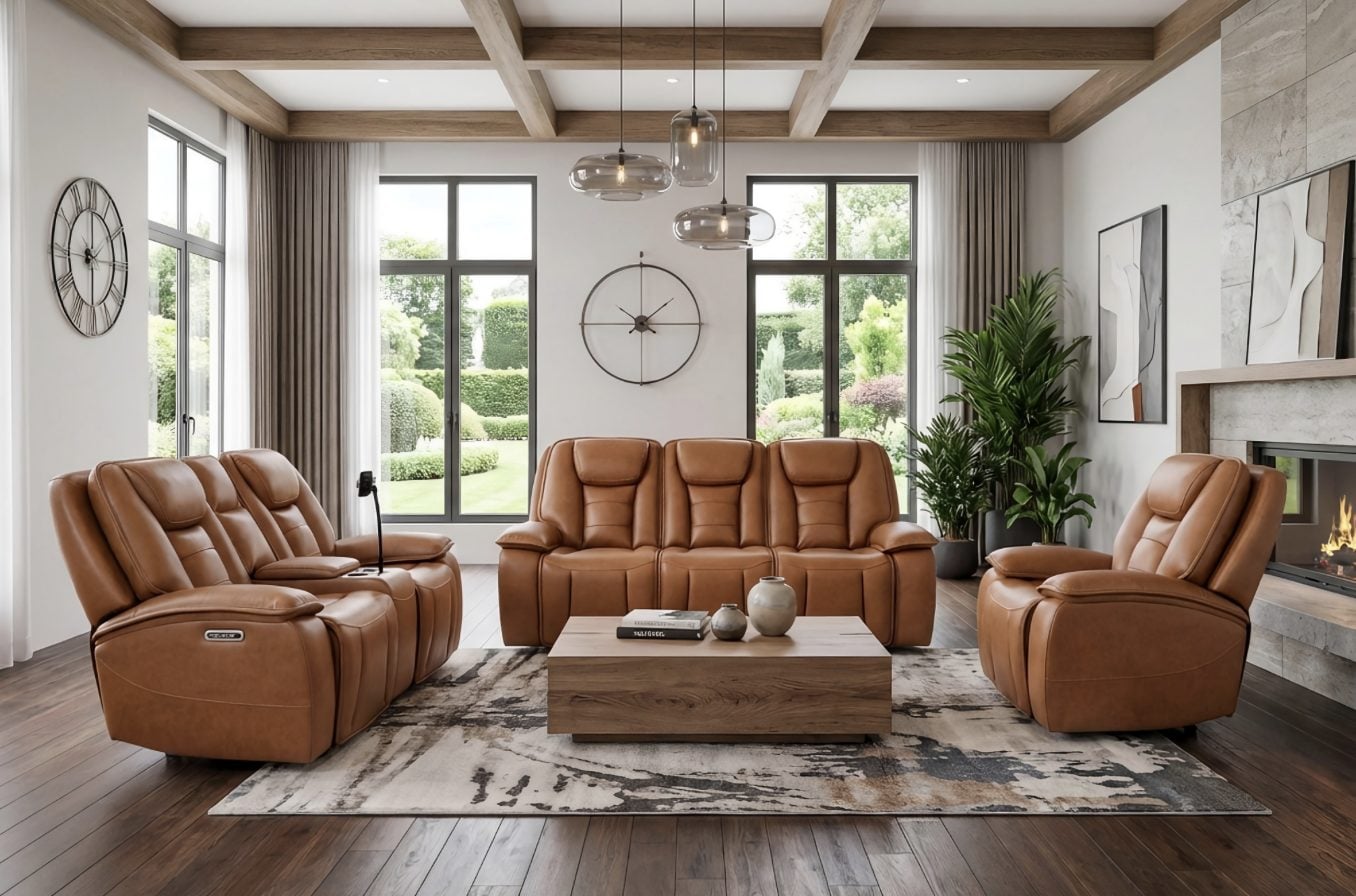
If you have shopped for a new sofa in the last few years, you have almost certainly hit the same fork in the road we see Edmonton families hit every week on our showroom floor: power or manual? Both put a footrest up and a backrest down, but the way they get there, what they cost to own over time, and how they fit a real household are genuinely different. Our [recliner sofas](/living-room/recliner-sofas) collection carries both formats side by side for exactly this reason, and this guide walks through the practical differences so you can walk in already knowing which one fits your living room.
This is not a question with one right answer. A young couple in a downtown condo, a family with two toddlers in Terwillegar, and a retired couple furnishing a quiet den in Sherwood Park will often land on completely different sides of this decision, and all three would be making the right call for their household. What matters is understanding the trade-offs before you sit down in the showroom, rather than discovering them after delivery day.
What Is Actually Different Between a Power Recliner and a Manual Recliner
A manual recliner reclines using a mechanical lever or a push-back motion — you pull a handle, or you lean your weight back against the seat, and a set of springs and linkages carries the footrest up and the backrest down. There is no motor, no wiring, and nothing to plug in. It is the same basic mechanism recliners have used for decades, refined for smoother motion and better support at each stop.
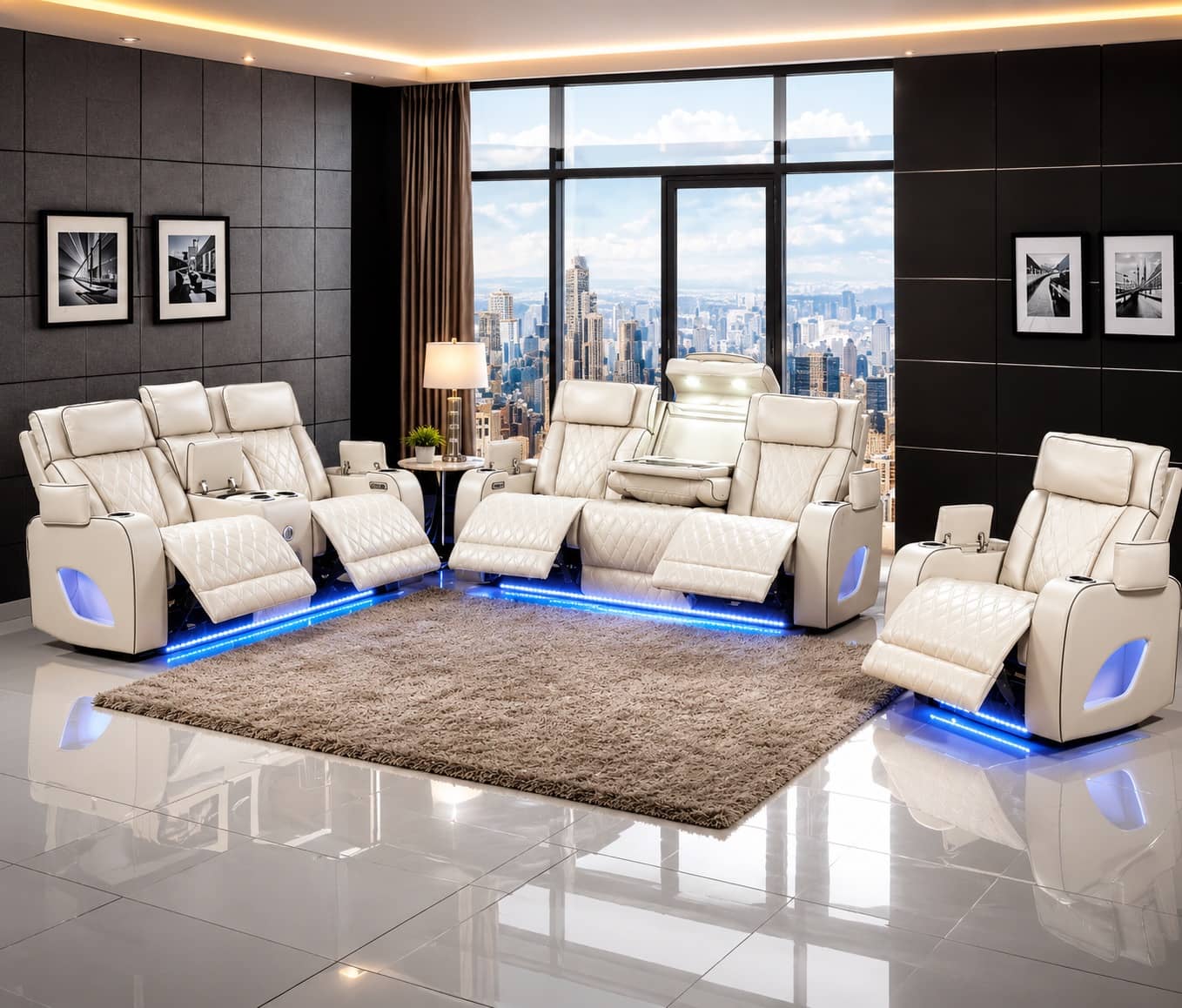
A power recliner replaces that lever with a small motor and a control pad, usually mounted on the arm or on a wired remote tucked into a side pocket. Press a button and the motor moves the footrest and backrest together, typically stopping smoothly at whatever position you release the button at, rather than only at a handful of preset stops the way older manual designs sometimes do. Many power recliner sofas add extras on top of the basic motion — adjustable headrests, USB charging ports built into the console, and independently reclining seats on a multi-seat sofa so each person can set their own angle without disturbing anyone else on the same piece.
The core trade-off comes down to this: manual recliners are simpler, lighter, and have nothing electronic to eventually need attention, while power recliners trade that simplicity for one-touch ease, finer control over the recline angle, and features that a manual mechanism cannot offer.
How Manual Recliners Work — and Why Some Buyers Still Prefer Them
Manual mechanisms rely on tension springs and a locking linkage. Pull the side lever, and the linkage releases, letting your body weight carry the footrest out and the seat back. Push back against the seat firmly and the same thing happens on a push-back recliner, with no handle to find at all. Return to upright by sitting forward and pushing the footrest down, or pulling the lever again depending on the model.
Because there is no motor, no wiring, and no control board, a manual recliner has dramatically fewer parts that can eventually need service. There is nothing to unplug, no cord routing to plan around when you arrange the room, and no risk of the mechanism being unusable during a power outage. For a secondary den, a rec room, a cabin, or any spot where a household wants a comfortable recliner chair without thinking about it further, manual remains the straightforward, dependable choice — which is exactly why it has not disappeared from showroom floors even as power options have become more popular.
The trade-off is physical effort and fewer stopping points. Reclining and returning upright both take a small amount of strength and a full-body motion, which matters more for anyone with limited mobility, a bad back, or young kids who want to operate the chair themselves. Most manual recliners also lock into two or three fixed positions rather than letting you stop at any point along the way, so fine-tuning the exact angle is not always possible.
How Power Recliners Work — and What Happens in an Alberta Power Outage
Power recliners use a low-voltage motor, typically run off a standard household outlet through a small transformer, controlled by a button or a small toggle switch. Hold the button and the motor drives the footrest and backrest smoothly to any position in between fully upright and fully reclined, then holds there when you let go. Because the motion is motor-driven rather than momentum-driven, power recliners also make it easy to build in features that would be awkward on a manual chair — independently reclining seats on a multi-seat sofa, adjustable power headrests, and consoles with built-in USB charging.
The practical question we hear most from Edmonton buyers is what happens to a power recliner sofa when the power actually goes out — a fair question in a province where winter storms do knock out power on occasion. Without backup power, a power recliner simply stays wherever it was left when the outage started; the motor cannot move without electricity, and there is no manual override lever hidden underneath most designs. If the chair happens to be reclined when the power cuts, it stays reclined until power returns. This is rarely a real inconvenience, since most households are not mid-recline during an outage, but it is worth knowing before you buy, especially if the recliner will serve as the main seating in a room. A battery backup pack — a small rechargeable unit that sits inline between the cord and the outlet — is available as an add-on for exactly this scenario and gives you enough charge to move the chair to upright even without wall power.
Power recliners also need a nearby outlet and a sensible cord path, which is worth planning for before delivery day rather than after. If your living room layout does not have an outlet near where the sofa will sit, that is a detail to sort out with an electrician ahead of time, not a surprise on move-in day.
Comfort, Ease of Use, and Who Benefits Most From Power
For anyone who finds bending, reaching, or pulling a lever physically difficult — arthritis, a recent surgery, a bad shoulder, or simply the daily wear of a physical job — a power recliner removes almost all of the effort from getting comfortable. A light touch on a button does the work a manual lever asks your whole body to do, and the ability to stop at any angle rather than a fixed set of positions means you can fine-tune support for reading, watching a movie, or a full afternoon nap without settling for "close enough."
That same one-touch convenience is also simply a nicer everyday experience for households that recline often — evenings in front of the television, a Sunday afternoon after a big family dinner, or a household member who spends real time in one favourite seat. If the recliner chair or sofa in question is going to be used for hours most days, the incremental cost of power tends to feel worthwhile fairly quickly.
Manual recliners hold their own where the chair sees lighter, more occasional use — a guest bedroom, a home office reading corner, or a basement rec room where "good enough" positions are genuinely good enough. The physical motion of reclining and returning upright is also, for some people, simply a non-issue and not worth paying for a motor to solve.
Longevity and Maintenance: Fewer Parts, Fewer Problems
This is the area where manual recliners have a real, lasting advantage. A mechanical recliner mechanism is essentially springs and hinges — there is very little to go wrong, and what does go wrong (a loose linkage, a worn spring) is usually a straightforward repair. Because there is no motor and no wiring, there is nothing electronic to eventually need attention, and the mechanism itself tends to outlast the upholstery around it.
Power recliners add real convenience, but the motor, wiring, and control board are additional components that a manual chair simply does not have. Quality construction and proper use — not routinely forcing the footrest open or closed, and not leaning on the console — go a long way toward a long service life either way, and this is one of the reasons we encourage buyers to sit in and actually test the motion of any recliner sofa on our showroom floor before ordering, rather than deciding from a photo alone.
Either format benefits from the same basic care: keep pets and small objects away from the mechanism underneath the seat, avoid leaning heavily on an open footrest, and vacuum along the seams and mechanism area periodically so lint and debris do not build up around moving parts.
Recliner Chair or Recliner Sofa? Matching the Format to Your Room
Not every household needs a full reclining sofa. A single recliner chair — power or manual — is a common choice for a reading corner, a home office, or as a second seat paired with a standard sofa in the living room, and it is a good way to try either mechanism before committing to a full multi-seat piece. For a room built around shared seating, a reclining sofa or loveseat with two or three reclining positions lets a whole household relax together, with each seat typically operating independently so one person can recline while another stays upright.
If your living room is doing double duty as a media room and a space for hosting guests, an increasingly popular option is a mix — a reclining sofa for the main seating, paired with a single manual or power recliner chair off to the side for a spot that reclines without dominating the room's footprint. Our design team walks through this kind of layout question with Edmonton households regularly, and it is exactly the sort of decision that is easier to make in person, in front of the actual pieces, than from measurements alone.
Space Planning: How Much Clearance Does a Recliner Actually Need
Standard recliner mechanisms need real clearance behind the chair — typically somewhere in the range of 12 to 18 inches between the back of the sofa and the wall — because the backrest tips backward as part of the recline motion. If your living room layout has the sofa backed up against a wall with little room to spare, this is worth measuring before you fall in love with a specific piece.
Wall-hugger designs, sometimes marketed as zero-wall or zero-clearance recliners, solve this by sliding the seat cushion forward as the chair reclines, so the backrest tips within just a few inches of the wall instead of over a foot. They are a genuinely useful option for condos, smaller living rooms, and any layout where a sofa has to sit close to a wall. Whichever style you choose, also plan for clearance in front of the piece — the extended footrest needs roughly 16 to 18 inches of open floor space, plus enough of a walkway around the whole footprint that reclined seating does not block a path through the room.
Safety Considerations for Homes With Kids or Pets
Any recliner mechanism, manual or power, moves with real force, and the most common household injury is a pinched finger, hand, or paw caught as the footrest closes or the mechanism folds underneath the seat. This is worth taking seriously in a home with young children or pets that like to explore under and around furniture.
A few habits go a long way: return the recliner to the closed, upright position when it is not actively in use, never let kids sit or stand on an open footrest, and take a quick look around and underneath the chair before closing it, especially if a pet has been anywhere nearby. Power recliners with a slow-close motor reduce the risk further, since the motor-driven motion is more controlled and gives more reaction time than the faster snap of some manual mechanisms. If young children or curious pets are a daily reality in your home, it is worth mentioning to our team when you visit — we can point you toward the mechanisms and features best suited to a busy household.
Reclining Sectionals: The Whole-Room Alternative
For larger living rooms, or households that want reclining comfort built into a bigger seating arrangement rather than a standalone sofa, a [reclining sectional](/living-room/sectional-sofas) is worth a look. Sectionals let you combine reclining seats with stationary corner and console sections in one connected piece, which works well for open-concept Edmonton living rooms where the sofa is visible from the kitchen and dining area and needs to anchor the whole space rather than sit against one wall. The same power-versus-manual decision applies section by section, and it is common to see a sectional built with power recline on the two end seats and a stationary or manual middle section.
Fabric and Leather Considerations for Recliners
The upholstery on a recliner sees more movement and more direct contact than a stationary sofa, since the fabric across the backrest and footrest stretches and flexes with every recline. A tightly woven, durable fabric or a quality leather handles that repeated motion better than a loosely woven or delicate material, and either can look and perform well over years of daily use when the construction underneath is solid. If your household includes pets, a performance fabric that resists snagging is worth asking about specifically, since claws and a moving mechanism are not always a friendly combination.
Whichever material you lean toward, testing the actual recline motion in the showroom — not just sitting on the cushion — is the best way to judge how a specific piece will feel and hold up in your home, which is one more reason we encourage a visit rather than an online order alone.
Making the Call: A Simple Way to Decide
If you are still torn, a few quick questions tend to settle it. Does anyone in the household have mobility limitations that make lifting a footrest by hand genuinely difficult? Power is the easier answer. Will the recliner see heavy daily use, or occasional weekend use in a guest room or den? Heavy daily use tends to justify the extra convenience of power, while occasional use often does not need it. Is the room laid out with an outlet nearby, or would adding one mean an extra step before delivery? And finally, does simplicity and long-term low maintenance matter more to your household than one-touch convenience and extra features?
A quick way to sort your own thinking before your showroom visit:
- Lean power if: someone in the household has limited mobility, the recliner will see daily use, an outlet is already nearby, and you want independently adjustable seats on a multi-seat sofa.
- Lean manual if: the piece is for occasional use, you want the fewest possible parts that could ever need attention, or the room has no convenient outlet.
- Consider a wall-hugger version of either if the sofa has to sit close to a wall in a smaller living room or condo.
- Consider a reclining sectional if you are furnishing a larger or open-concept room rather than a single seating wall.
There is no wrong answer here — only the one that matches how your household actually lives.
Visit Our Showroom to Compare Both in Person
Reading about the difference between a power recliner and a manual recliner only goes so far — the real test is sitting in both, side by side, and feeling how each one moves. Our [recliner sofas](/living-room/recliner-sofas) collection is on the floor at our Gateway Blvd showroom for exactly that reason, alongside our full range of [living room](/category/living-room) pieces if you are furnishing more than one seat at a time.
Our design team can walk you through which mechanism, fabric, and layout suits your household, help plan clearance for your specific room, and talk through [financing](/financing) if you are outfitting the whole space at once. [White-glove delivery](/delivery) is included within Edmonton and available from $199 to Sherwood Park, St. Albert, Leduc, Beaumont, Spruce Grove, Stony Plain and Fort Saskatchewan. Come test both formats for yourself at [our showroom](/showroom) at 5817 Gateway Blvd NW, open seven days a week, or [reach out to our team](/contact) and we will help you compare power and manual recliner sofas before you buy.
Frequently asked questions
What is the main difference between a power recliner and a manual recliner?
A manual recliner uses a lever or push-back motion and mechanical springs to move the footrest and backrest, with no motor or wiring involved. A power recliner uses a small motor and a button or remote to move smoothly to any position and hold it there. Manual recliners are simpler and have fewer parts to eventually need attention, while power recliners trade that simplicity for one-touch ease and finer control over the recline angle.
What happens to a power recliner sofa during a power outage?
Without electricity, a power recliner cannot move, and there is no manual lever hidden underneath most designs to release it by hand. If the chair is reclined when the power goes out, it typically stays reclined until power returns. A rechargeable battery backup pack, available as an add-on, gives you enough charge to move the chair back to upright even without wall power - a useful option in a province where winter storms occasionally knock out electricity.
How much space does a recliner sofa need from the wall?
A standard recliner typically needs roughly 12 to 18 inches of clearance behind it, since the backrest tips backward as part of the recline motion. Wall-hugger, or zero-wall, designs slide the seat forward as the chair reclines instead, so they can sit within just a few inches of the wall. Either way, leave at least 16 to 18 inches of open floor space in front for the footrest to extend.
Are power recliners safe for homes with kids or pets?
Any recliner mechanism moves with real force, and the most common injury is a pinched finger, hand or paw caught as the footrest closes. Returning the recliner to the upright position when it is not in use, never letting kids sit or stand on an open footrest, and checking under and around the chair before closing it all reduce the risk considerably. Power recliners with a slow-close motor add an extra layer of control compared with a faster manual mechanism.
Do power recliners cost more to maintain than manual recliners?
Manual recliners have fewer components that can eventually need service, since there is no motor, wiring or control board involved - just springs and a mechanical linkage. Power recliners add genuine convenience, but the motor and electronics are additional parts a manual chair does not have. Quality construction and normal care go a long way with either format.
Can I get a reclining sectional instead of a single recliner sofa?
Yes - reclining sectionals combine reclining seats with stationary corner and console sections in one connected piece, which suits larger or open-concept living rooms well. It is common to mix power recline on the end seats with a stationary or manual middle section on the same sectional. Our design team can help you plan the configuration for your specific room.