King vs Queen Bedroom Sets: What Size Fits Your Room?
An Edmonton buyer's guide to choosing between a king and queen bedroom set, with real clearance numbers and how to measure your own room first.
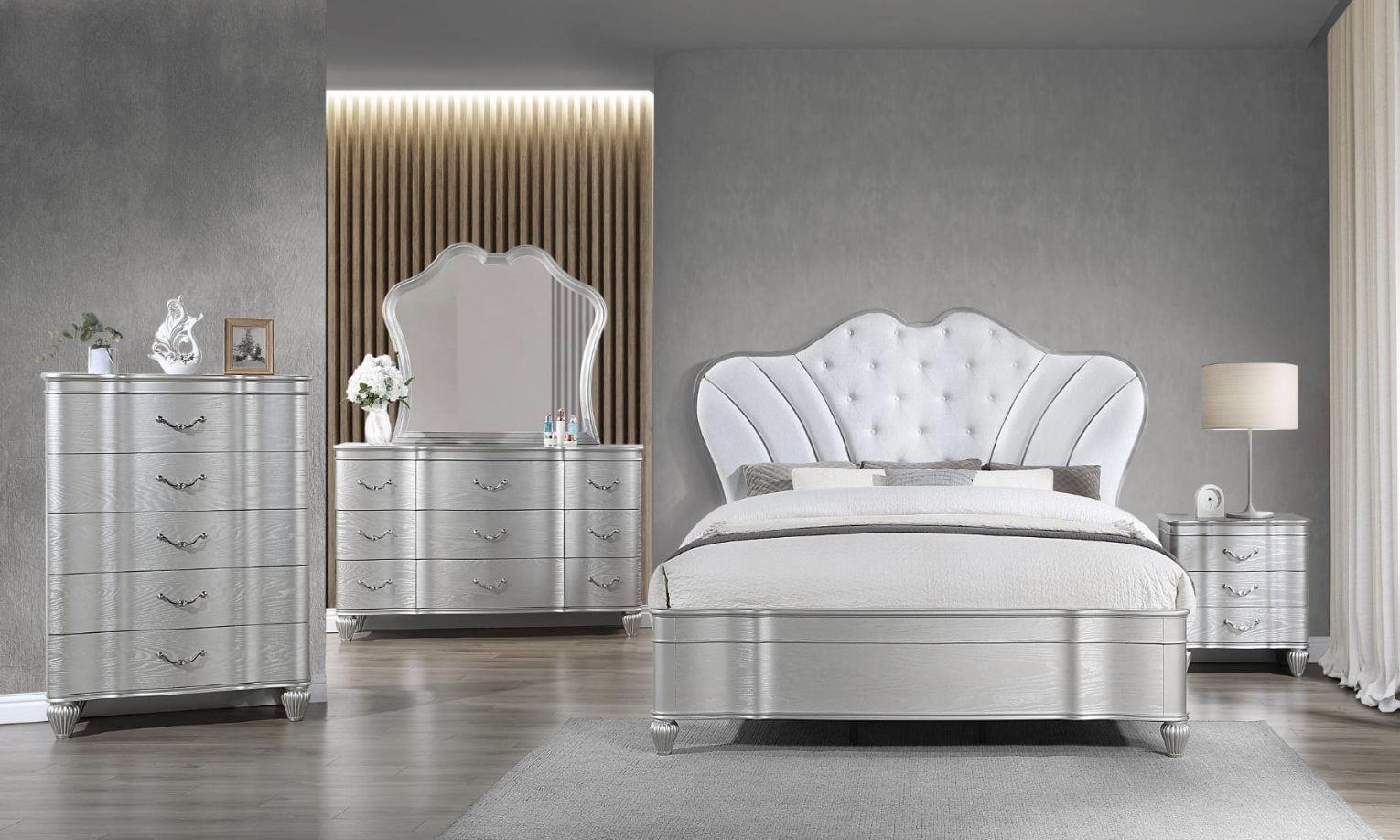
Choosing between a king and a queen is usually the first real decision in buying a bedroom set, and it is also the easiest one to get wrong from a screen. A bed that looks modest in a photo can dominate a real Edmonton bedroom, while a queen that feels "safe" can leave a larger room looking sparse. This guide walks through exactly how to decide, with real clearance numbers instead of guesswork.
We lay out complete [bedroom sets](/catalogue/bedroom-sets) against customers' actual room measurements on the showroom floor every week, and the size question comes up before almost anything else — finish, storage, style. Get the size right first and everything else gets easier.
Start with the numbers, not the look
A standard queen mattress measures about 60 inches wide by 80 inches long. A standard king measures about 76 inches wide by 80 inches long — the same length, about 16 inches wider. That 16 inches does not sound like much until it is sitting in the middle of your bedroom floor.
Once you add a frame, headboard and footboard, the footprint grows again:
- A queen bedroom set typically runs about 65 to 70 inches wide overall, depending on the headboard style.
- A king bedroom set typically runs about 80 to 86 inches wide overall, again depending on the headboard.
Those extra inches have to come from somewhere, and in most houses they come straight out of your walking space.
How much clearance you actually need
The comfort rule most designers use is about 30 inches of clear walking space on every side of the bed you actually walk around. Less than that and you end up turning sideways to get past; more than that and the room starts to feel like it is wasting floor space on empty carpet.
Here is how that plays out with a bed centred on one wall:
- Queen in a 10-foot-wide room: roughly 30 inches of clearance on each side once the bed is centred — workable, with slim nightstands.
- Queen in a 12-foot-wide room: comfortably over 30 inches on each side, with room for standard nightstands and easy walking.
- King in a 12-foot-wide room: close to the 30-inch minimum on each side — fine for walking, but tight if you want larger nightstands or a bench at the foot of the bed.
- King in a 14-foot-wide room: generous clearance on both sides, with room left over for a bench or a reading chair.
If your room is narrower than these, a king will still physically fit, but something else — nightstand size, a bench, an armchair — usually has to give first.
Measure before you fall in love with a set
Before you set foot in a showroom, measure your own room:
- Wall-to-wall width of the wall the bed will sit against, plus the two side walls if the bed sits in a corner.
- Door swings for the bedroom door and any closet doors, so a wide bed or dresser does not block them.
- Window and heat-vent positions. A tall headboard in front of a low window, or a dresser blocking a cold-air return, is a common Edmonton-winter regret.
- The path from the front entry to the bedroom — hallway width, stair turns, and tight doorway corners the pieces have to travel through on delivery day.
Bring those numbers with you. Our team can lay a king or a queen footprint out against your real measurements on the showroom floor in a couple of minutes, which settles the question far faster than staring at online photos.
When a king genuinely earns its space
A king is the right call when:
- The room is at least 12 to 14 feet wide and you want nightstands, a dresser, and comfortable walking room on both sides.
- Two people share the bed and one is a restless sleeper, or a child or pet regularly ends up in the middle of the night.
- You are furnishing a primary bedroom in a newer Edmonton build with larger room dimensions, where a queen can look visually small against the proportions of the room.
- You simply prefer more personal space while sleeping and are not fighting for every inch of floor space elsewhere.
When a queen is the smarter choice
A queen tends to be the better fit when:
- The room is under about 12 feet wide, especially in older Edmonton homes, condos, and townhomes where primary bedrooms often run smaller.
- You want room left over for a bench, an armchair, or a working desk in the same space.
- Moving day matters — a queen frame is noticeably easier to manoeuvre through narrow hallways, stairwells, and tight apartment doorways than a king.
- You are furnishing a secondary bedroom that occasionally doubles as a guest room, where a king can feel oversized for the room's everyday use.
Queen is also simply the most common size on the floor and in most households, which keeps bedding, mattress protectors and replacement parts easy to find later.
Case pieces: what stays the same between sizes
One detail that trips people up: the dresser, mirror, nightstands and chest in most bedroom collections are shared across bed sizes. Only the headboard, footboard and rails change between a king and a queen version of the same set. That means the finish, hardware and overall look of the room stays identical whichever bed size you choose — the decision really does come down to your room, not your taste in finish.
It also means you can change your mind on bed size later in some collections without replacing the whole room, as long as the same finish is still available and the case pieces are sold separately from the bed. Ask our team which pieces in a specific collection are shared or sold on their own before you commit.
Buying just a king bed frame versus a complete set
Not everyone starts from zero. If you already own a dresser and nightstands you are happy with and only need a king bed frame, you can usually buy the bed on its own rather than the full set — just confirm the finish is still close enough to match what you already have, since wood tones and metal hardware can vary subtly between production runs years apart. If you are starting fresh, a complete set is almost always the better value: the headboard, footboard, dresser and nightstands are finished and proportioned to work together, so you are not guessing at how a new bed frame will sit next to furniture bought separately. Either way, measure the frame itself, not just the mattress size, since headboard height and footboard depth both eat into the room beyond the mattress footprint.
What people searching for bed sets in Edmonton usually need to know
Most people searching for bed sets in Edmonton are really asking two separate questions at once: which size fits their room, and which finish fits their home. The size question is the one worth settling first, because it is the one measurement that will not change once the set is delivered — a finish you are lukewarm on can be refreshed with new bedding and a different lamp, but a bed that is physically too large for the room cannot be fixed with accessories. Once you know whether you are shopping king or queen, narrowing finish and style becomes a much smaller decision, and it is the part our showroom team is happiest to help with in person.
A quick layout test you can do tonight
You do not need a showroom to get a feel for the footprint. Use painter's tape (it will not mark your floor or walls) to outline the bed size you are considering directly on your bedroom floor — roughly 60 by 80 inches for a queen, 76 by 80 inches for a king. Walk around it for a day. If you are shuffling sideways past the taped outline more than once, that size is too tight for the room without other compromises.
Delivery day and tight spaces
Bed size matters on moving day too. A king frame, headboard and footboard take noticeably more manoeuvring through narrow stairwells, tight hallway turns, and apartment doorways than a queen does. If your home has a tricky entry — a narrow stairwell, a tight elevator, or a sharp hallway corner — mention it when you order so our delivery team can plan the route in advance. For a full walkthrough of how delivery day actually works, see our guide to [furniture delivery in Edmonton](/blog/furniture-delivery-edmonton-zones-timing).
Mattress and bedding practicalities
Whichever size you land on, a couple of practical notes save headaches later:
- Bedding is sized to the mattress, not the frame, so a king frame needs king sheets and a king duvet — queen bedding will not stretch to cover it.
- Replacement mattresses are easiest to find in queen, simply because it is the most common size carried by mattress retailers.
- A thicker pillow-top mattress adds height on top of the frame, which matters more in a king if the room already has a lower ceiling or a window close to headboard height.
Older versus newer Edmonton homes
Room size is rarely random — it tracks the age and style of the house. Many older south-side Edmonton bungalows and mid-century infills have primary bedrooms in the 10-to-11-foot range, which comfortably fits a queen but asks a lot of a king once a dresser and nightstands are in the room. Newer builds in communities further out, along with many show-home-style primary suites, are often drawn closer to 13 or 14 feet specifically to accommodate a king bed set and its case pieces. Condos and townhomes tend to run smaller again, which is exactly why queen remains the default recommendation for compact Edmonton living. None of this is a hard rule — measure your own room — but it explains why the "right" answer differs so much from one Edmonton household to the next, whether you are in the core, out toward the Henday, or in one of our surrounding service communities like [South Edmonton](/furniture-store/south-edmonton).
Bring the whole room into the decision
Size is the first decision, but it should not be made in isolation from the rest of the room. A king in a mid-sized room can work beautifully if you skip the bench and keep nightstands slim. A queen in a large room can feel intentional, not undersized, if you add a bench, a wider dresser, or a reading chair to balance the space. The goal is a room that feels proportionate when you walk into it, not simply the largest bed that technically fits through the door.
If you are still weighing finish, storage and the rest of the decision alongside size, our broader [guide to choosing a bedroom set in Edmonton](/blog/how-to-choose-a-bedroom-set-edmonton-2026) covers those details in full. And if budget is part of the conversation, remember that [financing can be arranged in showroom](/financing) on a complete set either way, so size does not have to be decided around a payment plan.
See both sizes side by side
The only way to really know how a king or a queen will live in your room is to stand next to both. Come measure against the floor models at [our Gateway Blvd showroom](/showroom) at 5817 Gateway Blvd NW — we are open Monday to Saturday 10:30am to 8pm and Sunday noon to 6pm, and our designers will walk your room's measurements against both sizes with no pressure to decide that day. Ready to bring in your measurements? Browse the full range of bedroom furniture sets Edmonton shoppers are choosing right now at our [bedroom sets collection](/catalogue/bedroom-sets), [get in touch](/contact), or call (825) 404-9043 — we will tell you honestly which size fits your room.
Frequently asked questions
Is a king or queen bed better for a couple?
Both work well for two people. A queen gives each sleeper roughly 30 inches of width, which is enough for most couples. A king gives each sleeper close to 38 inches, which matters more if you share the bed with a restless sleeper, a pet, or a child who climbs in overnight. If sleep space has never been an issue for you, a queen is usually the simpler, more flexible choice.
What size room do you need for a king bedroom set?
As a working minimum, aim for a room at least 12 feet wide so a king frame leaves roughly 30 inches of clearance on each side for walking and nightstands. Smaller than that and you can still fit a king, but you may need to use slimmer nightstands or skip a bench at the foot of the bed. Measure your actual room before you shop rather than relying on a general rule.
Will a queen bedroom set look too small in a large primary bedroom?
Not necessarily. A queen set can look proportionate in a larger room if the rest of the furniture is sized to match — a wider dresser, a bench at the foot of the bed, or a pair of larger nightstands can fill the room without upsizing the bed itself. Some buyers actually prefer the extra floor space a queen leaves in a big room.
Do king and queen bedroom sets use the same dressers and nightstands?
Often yes. Most complete sets are built so the case pieces — dresser, mirror, nightstands, chest — are shared across bed sizes, and only the headboard, footboard and rails change. That means you can usually choose the bed size based on the room and keep the same finish and case pieces either way. Confirm with our team which pieces in a specific set are shared across sizes.
How much wider is a king bed frame than a queen?
A queen mattress is about 60 inches wide; a king mattress is about 76 inches wide, so the king is roughly 16 inches wider, with both typically 80 inches long. Once you add a frame, headboard and footboard, a queen set usually runs about 65 to 70 inches wide overall and a king set about 80 to 86 inches wide, so always check the actual frame width rather than the mattress size alone.
Can I switch from queen to king later without replacing the whole set?
Sometimes, if the dresser, mirror and nightstands in that collection are sold separately from the bed and the same finish is still available when you're ready to upgrade. It is not guaranteed across every collection, so if you think you may upsize later, ask our team which case pieces are sold independently before you buy.