Dining Chairs Buying Guide: Fabric, PU or Wood Legs
An Edmonton guide to dining chairs: fabric vs PU upholstery, gold, silver or wood-tone legs, seat height and the checks that matter before you buy.
A dining chair gets picked up, pulled out, leaned back on and bumped into a table edge more times in a year than almost anything else in the house. Yet most people spend weeks picking the table and about thirty seconds deciding what to sit on. That is the wrong way around, because the chairs are what your household actually touches at every single meal.
This guide walks through the decisions that matter when you are shopping for [dining chairs](/dining/dining-chairs): fabric versus PU upholstery, gold, silver or wood-tone legs, the seat height and spacing that make a set of dining room chairs comfortable to sit at, and the quality checks worth doing before you commit. It is written from what our designers at the Gateway Blvd showroom walk Edmonton households through every week, not a generic style roundup.
Start with the seat height, not the look
It is tempting to shop by style first and worry about fit later, but a beautiful chair that sits at the wrong height will bother everyone who uses it, every single day. Get the height right first, and the style decision gets easier because you have already narrowed the field.
As a working rule, you want roughly 10 to 12 inches of clearance between the top of the seat and the underside of the tabletop. For a standard dining table around 29 to 30 inches tall, that puts a comfortable seat height in the 17 to 19 inch range, measured at the front edge of the seat cushion, not the back.
A few things throw this off:
- Chairs with arms need to slide fully under the table, or at least close enough that no one is left sitting a foot back from their plate. Check the arm height against your tabletop's underside before you buy, not after delivery.
- Thick seat cushions compress a little under weight, so the showroom measurement is close but not exact. A half-inch either way is normal and rarely noticeable.
- Counter and bar height seating is a different category entirely and will feel wrong — too low or dangerously high — at a standard table. If you are shopping for an island or a pub-style table instead of a standard dining table, that changes this whole conversation.
If you already own the table, bring its height (or better, a photo and a tape measure reading) when you visit, and we will check a few chair options against it on the spot.
Fabric or PU: what the difference actually means day to day
Our dining chairs come upholstered in either fabric or PU, on the same range of leg finishes. Neither is better in the abstract — they suit different households, and it is worth being honest about the trade-off rather than picking on looks alone.
To be clear on one point up front: PU is not leather. It is a polyurethane-coated fabric designed to look and feel similar to leather at a lower cost and with easier care, and we describe it as PU because that is what it is. If a leather dining chair matters to you specifically, ask our team — it is not something every piece in our range offers.
Fabric feels warmer against bare skin, breathes better through a long dinner, and tends to look more at home in a softer, textured dining room. The trade-off is upkeep: a spill needs attention quickly, and fabric will show general wear — a slight sheen on the seat edge, a touch of flattening — sooner than PU does, especially under a toddler or a dog that likes to beg under the table.
PU wipes clean in seconds, which matters enormously if your dining table doubles as a kids' homework station, a craft table, or the spot where a toddler eats most meals. It resists spills and odours far better than fabric, and it suits a cleaner, more contemporary look. The trade-off is feel: PU does not breathe the way fabric does, so it can feel a little cool or slightly sticky on bare skin during a hot afternoon, and over many years of heavy daily use any PU surface will eventually show its age faster at the seams and edges than a well-chosen fabric does.
Our rough guidance: if your dining table sees young kids, pets, or daily use beyond mealtimes, lean PU. If it is a more formal space used mainly for sit-down dinners, fabric usually earns its keep in comfort and feel. Many households split the difference — PU on the everyday chairs at the ends people use constantly, fabric on the chairs reserved for guests.
Gold, silver or wood-tone legs
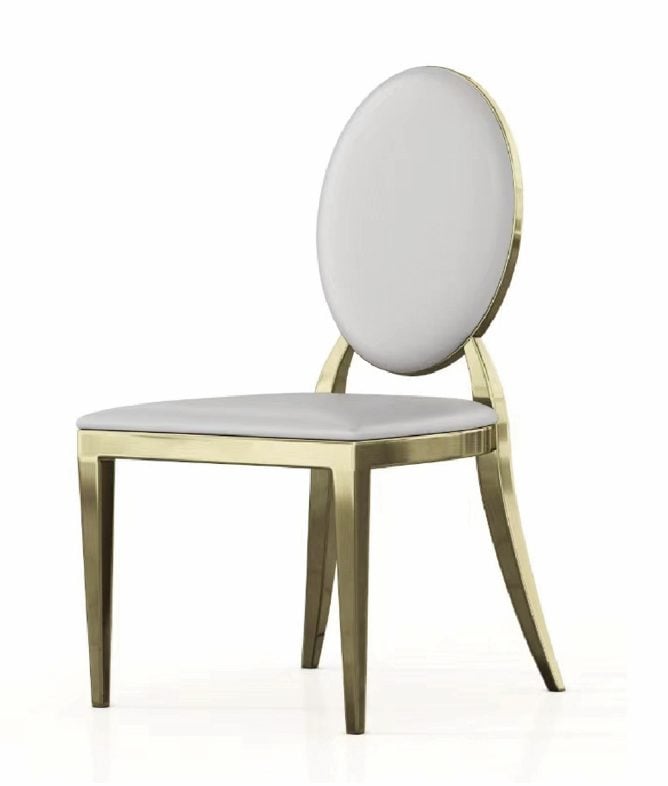
Leg finish is where a dining chair either disappears into the room or becomes the detail that pulls the whole table together. Our range runs on gold, silver or wood-tone legs, and each reads differently depending on what else is in the room.
- Gold legs warm up a room and pair naturally with navy, cream, blush and deep jewel-toned upholstery. They photograph beautifully and suit a dining room that wants a bit of presence, but they show water spots and fingerprints more visibly than a darker finish, so wipe them down as part of your normal table cleanup.
- Silver legs feel cooler and more contemporary, and they are the most forgiving finish to mix with other metals already in the room — a chrome light fixture, stainless hardware in an open-concept kitchen, or black window frames. They tend to recede visually, which is useful if you want the upholstery colour to do the talking.
- Wood-tone legs are the warmest and most traditional option, and they are usually the easiest to match to an existing dining table rather than buying the table and chairs as a matched set. They blend into a room that already leans toward wood flooring, trim or cabinetry.
None of our leg finishes change the comfort or durability of the chair on their own — that comes down to the frame and the upholstery — so choose the finish based on the room, not on an assumption that one option is sturdier than another.
How many chairs, and how much space each one needs
Getting the count and spacing right prevents the two most common dining chair complaints: elbows knocking at every meal, and a table that looks sparse with only four chairs around it.
Plan on roughly 24 inches of width per person along the table edge, and a minimum of 24 to 30 inches of clear space behind each chair so someone can push back and stand without bumping the wall, a sideboard or the person behind them. A table that seats six comfortably needs real floor space beyond the table itself — measure the room, not just the table, before you settle on a chair count.
If your table has a fixed number of chair positions, resist the urge to squeeze in one more "for big dinners." A table that is genuinely too tight for its chair count gets uncomfortable fast, and everyone notices on the third course, not the first. An [extendable dining table](/dining/dining-tables) paired with a smaller everyday chair count, plus a couple of extra chairs stored elsewhere for when family visits, is usually the more livable answer than permanently crowding six chairs around a table built for four.
Arms, no arms, and the captain's chair question
Most dining sets are armless, and for good reason — armless chairs slide under the table cleanly, take up less width, and work at every seat around the table without a height mismatch. Save the arms for the ends.
A pair of captain's chairs with arms at the head and foot of the table is a classic way to add a little visual variety and a touch more comfort for whoever sits there longest, without changing the seating count or the table length. The only thing to confirm before you commit is the arm height against your tabletop — an arm that is even slightly too tall will stop the chair from tucking under the table properly, and you will notice it at every meal.
If your dining area doubles as a home office or a long-session homework spot, arms at both ends genuinely help with comfort over a longer sit. If the room is mainly used for quick meals, armless all around is simpler and gives you one less thing to measure.
What to check before you buy
A dining chair takes more daily stress than almost any other seat in the house — it gets pulled out, sat in, leaned back on, and bumped against the table edge at every single meal. A few checks on the showroom floor tell you a lot about how a chair will hold up.
- Sit down and shift your weight. A well-built frame should feel solid underneath you, with no flex, creak or wobble when you lean side to side.
- Check the joints where the legs meet the seat frame. This is the point that takes the most repeated stress over years of use, and it is where a poorly built chair fails first.
- Run a hand along the upholstery seams, especially on PU pieces, where the seams are the first place wear shows.
- Push down on the seat cushion and let go. It should spring back rather than staying compressed, which tells you something about how the chair will feel in year three, not just on day one.
- Check how the chair sits on your actual flooring. A chair that scrapes or marks hardwood needs felt pads, which are an easy, inexpensive fix worth doing on day one rather than after the first scuff mark.
Caring for fabric and PU through an Edmonton year
Alberta's dry winters and the swing between a humid August and a bone-dry, furnace-heated January affect dining chairs less than they affect a leather sofa, but a little seasonal care still goes a long way.
For fabric chairs, vacuum the seams regularly to keep crumbs and dust from working into the weave, and treat any spill immediately with a clean cloth and cold water rather than letting it set. A fabric protector applied when the chairs are new makes everyday spills far easier to manage without changing how the upholstery looks or feels.
For PU chairs, a damp cloth and mild soap is normally all you need. Avoid harsh solvents or abrasive cleaners, which can dull the surface or cause it to crack over time, and keep PU pieces a reasonable distance from direct heat vents, since constant warm, dry air is harder on any synthetic upholstery than it is on fabric.
For either finish, a quick wipe or vacuum after meals with young kids takes thirty seconds and saves a much longer cleaning job later. The chairs that age best in our showroom experience are rarely the most expensive ones — they are the ones that got a little regular care from day one.
Matching chairs to a table you already own
Not everyone is buying a table and chairs together, and mismatched sets are a completely normal, often more interesting choice than a boxed set. A few things make a mixed pairing look intentional rather than accidental.
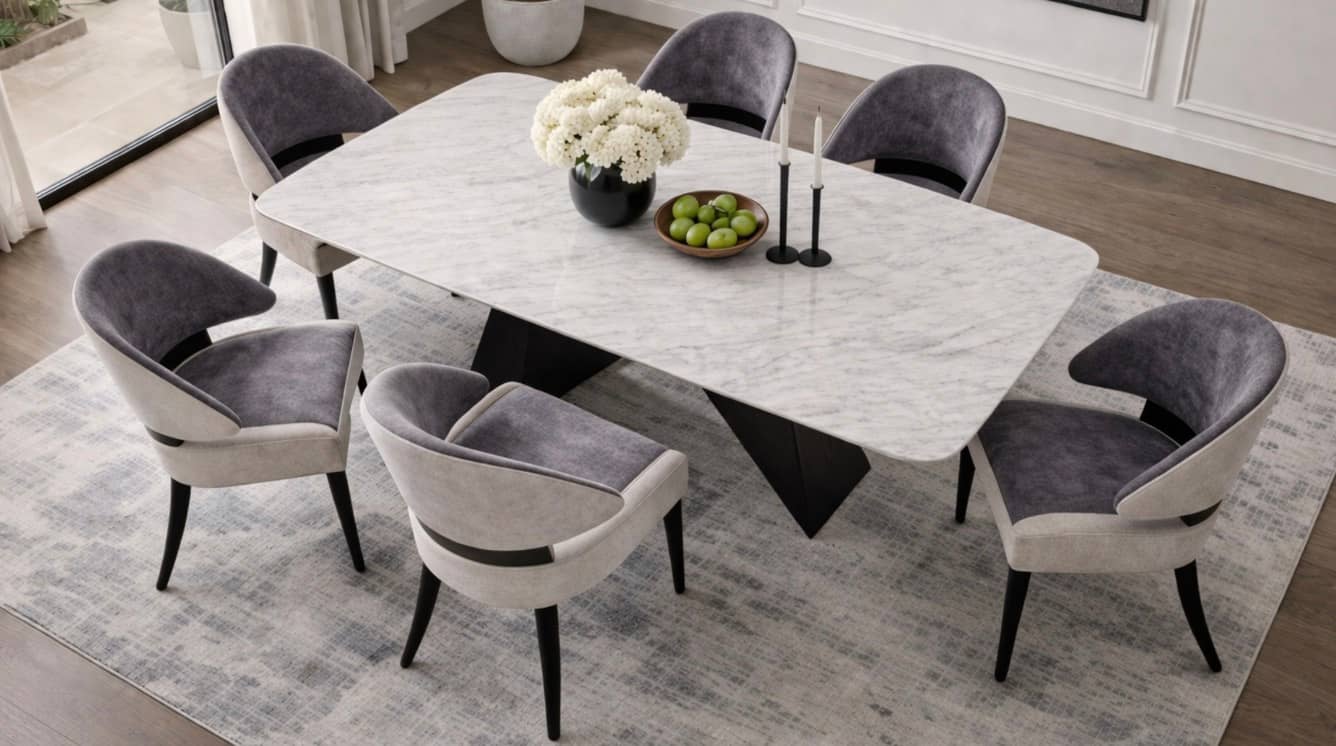
Match the leg finish or tone to something already in the room — a wood-tone chair leg against a glass or stone table reads as a deliberate contrast, while a leg finish that fights the table's base or the room's existing metal tones can look like an afterthought. If you are unsure, bring a photo of your table (or the table itself, if you are shopping before delivery) and we will hold a few leg finishes against it in person.
Keep the seat height rule from earlier in mind regardless of where the chairs came from — a chair bought to match a different table at a different height is the single most common reason a secondhand or hand-me-down chair never quite works at a new table. If you already have a dining table and are only replacing the chairs, our guide to [dining table sizing](/blog/dining-table-size-guide-edmonton) is useful background on how table height and shape interact with seating.
Mistakes we see most often
- Buying on looks alone and skipping the height check. This is the single most common regret, and it is the easiest one to avoid with a tape measure before you order.
- Choosing fabric for a high-traffic family table out of pure style preference, then fighting stains for years afterward. Be honest about how the table actually gets used.
- Assuming all leg finishes are equally durable. They are close, but gold and silver finishes show fingerprints and water spots more visibly and need a slightly more frequent wipe-down than a wood-tone leg.
- Underestimating the clearance behind each chair. A table that fits six chairs at the edge can still be unusable if nobody can push their chair back far enough to stand up comfortably.
- Ordering armchairs for every seat without checking tabletop clearance. Reserve arms for the ends, or confirm the height against your table first.
Come sit in them before you decide
Photographs tell you almost nothing about how a dining chair actually feels — the seat depth, the back angle, and the way PU or fabric meets your skin only make sense once you sit down. Visit our [Gateway Blvd showroom](/showroom) at 5817 Gateway Blvd NW and sit at a full table setting rather than a single display chair, since that is the only way to judge spacing and comfort honestly.
Most of our [dining chairs](/dining/dining-chairs) are special order, with a typical lead time of about four to eight weeks, so it is worth starting the decision a little ahead of when you need the table ready. Bring your table's height and your room dimensions, browse the wider [dining collection](/catalogue/dining-sets) while you are here, and our designers will walk you through fabric, PU and leg finish against your actual space. White-glove [delivery](/delivery) is included across Edmonton, and flexible payment plans are arranged right in the showroom. [Get in touch](/contact) or call (825) 404-9043 and we will have a few options ready to sit in when you arrive.
Frequently asked questions
Is PU the same as leather on a dining chair?
No. PU is a polyurethane-coated fabric made to look and feel similar to leather, at a lower cost and with easier everyday care. We describe it as PU because that is what it is, never as leather.
What seat height works with a standard dining table?
For a table around 29 to 30 inches tall, look for a seat height in the 17 to 19 inch range, measured at the front edge of the cushion, so there is roughly 10 to 12 inches of clearance under the tabletop.
Should I choose fabric or PU dining chairs for a family with young kids?
PU is usually the easier choice for a table that sees daily spills, since it wipes clean in seconds and resists stains far better than fabric. Fabric suits a more formal dining space with lighter everyday use.
Do gold, silver and wood-tone legs differ in durability?
Not meaningfully - durability comes from the frame and joints, not the leg finish. Gold and silver finishes do show fingerprints and water spots more visibly than a wood-tone finish, so they need a slightly more frequent wipe-down.
How much space does each dining chair need around the table?
Plan on about 24 inches of width per person along the table edge, plus 24 to 30 inches of clear space behind each chair so it can push back and someone can stand up comfortably.
How long does it take to get dining chairs from Gateway Furniture?
Most of our dining chairs are special order, with a typical lead time of about four to eight weeks. Ask our team which pieces are on the showroom floor and ready sooner.